What road charge applies to an HGV in each country?
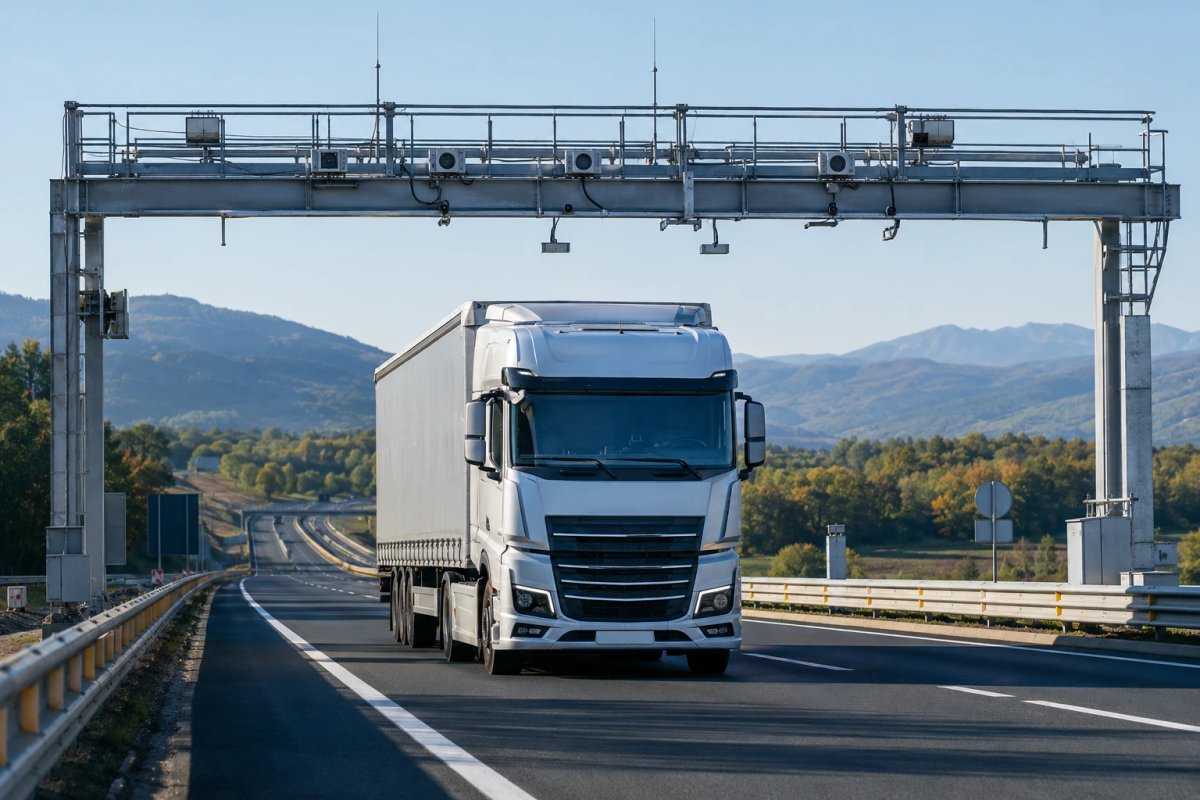
A goods vehicle over 3.5 tonnes does not use the same type of “vignette” in all four countries. Bulgaria, Hungary and Austria charge heavy goods vehicles by distance. Romania keeps its legacy time-based rovinieta for these vehicles through 30 September 2026, then applies TollRo from 1 October. The 31 August date is the system implementation milestone, not the start of TollRo charging.
There is no reliable single Europe-wide rate per kilometre. The amount changes with the country, route, road class, vehicle or combination mass, axle count and emissions data. A real trip therefore needs a separate calculation in each national system.
This article is informational and was checked on 18 August 2026. For a specific journey, use the current instructions and tools published by CNAIR, BG Toll, HU-GO and GO-Maut. Rates, tolled networks and payment channels can change.
Romania, Bulgaria, Hungary and Austria at a glance
| Country | Vehicle scope in this guide | Charging basis | Main price inputs | Payment or device | Official source | Value basis |
|---|---|---|---|---|---|---|
| Romania | Goods vehicle with maximum authorised total mass over 3.5 t | Rovinieta through 30 September; distance-based TollRo from 1 October | Road class, kilometres, vehicle mass and EURO class | The law provides for a SETRo provider, route ticket or app; operational launch channels had not been published by 18 August | CNAIR clarification; no operational TollRo tool had been identified | TollRo unit rates are in lei and include VAT |
| Bulgaria | Vehicle with total technically permissible maximum weight over 3.5 t | Distance-based toll | Calculator GCWR, total axles, EURO, CO₂, road and date | Compatible OBU/GPS service or route card | BG Toll calculator | The public tool reviewed did not clearly state its VAT basis |
| Hungary | Vehicle with maximum authorised total mass over 3.5 t | Distance-based HU-GO | J2–J5, road type, zone, environmental category and CO₂ component | OBU or route ticket | HU-GO calculator | The tariff page labels its values gross in HUF; retain the basis shown for the actual calculation |
| Austria | Vehicle over 3.5 t maximum technically permissible laden mass | Distance-based GO toll | Axles, CO₂ class, EURO class, vehicle type and section | GO-Box, Toll Collect OBU or EETS OBU | GO toll calculator | Published standard rates exclude 20% VAT |
This table compares systems and required inputs, not the price of one journey. Romania–Bulgaria and Romania–Hungary–Austria are separate route branches; Bulgaria and Hungary are not consecutive legs of a mandatory four-country corridor.
Romania: rovinieta through 30 September, TollRo from 1 October
CNAIR clarified the timeline on 7 August 2026:
| Date | Meaning for goods vehicles over 3.5 t |
|---|---|
| 31 August 2026 | Implementation milestone for the STRR and TollRo infrastructure and systems; TollRo charging does not start on this date |
| Through 30 September 2026 | The legacy truck rovinieta remains the applicable regime |
| 1 October 2026 | TollRo charging starts; legacy rovinietas for goods vehicles over 3.5 t cease to be valid |
| 15 January 2027 | European Electronic Toll Service interoperability is scheduled to become operational |
TollRo applies to vehicles designed and built for carrying goods with a maximum authorised total mass, called MTMA in Romanian documents, above 3.5 tonnes. Mixed-use vehicles are treated as goods vehicles. Buses and other passenger vehicles are outside this TollRo category.
Article 24 of Law 226/2023 allows the user to request in writing a refund for the unused period of a legacy rovinieta that ceases to be valid. Refunds follow the implementing rules, so check CNAIR’s current procedure before submitting a request.
No operational TollRo calculator or complete launch-channel list had been published by 18 August 2026. The law describes a SETRo provider, a single-trip route ticket and a mobile app as payment designs, but operators planning travel from 1 October should recheck CNAIR’s launch instructions before departure.
Illustrative calculation after 1 October
Transport Ministry Order 1,925/2025 sets a unit rate of 0.48 lei/km on motorways and expressways and 0.24 lei/km on national roads for a EURO VI goods vehicle of at least 12 tonnes. These rates include VAT.
For an illustration with 400 km of motorway or expressway and 100 km of national road:
400 km × 0.48 lei/km + 100 km × 0.24 lei/km = 216 lei, VAT included.
This demonstrates the statutory formula; it is not a route quote. It excludes bridges, other special charges and provider fees. Road tolls are only one input in the real transport cost per kilometre.
Bulgaria: distance toll, not an e-vignette, for HGVs
Bulgaria has charged vehicles over 3.5 tonnes by distance since 2020, replacing the electronic vignette for that category. The e-vignette price change from 1 August 2026 applies to vehicles up to 3.5 tonnes and M1 motor caravans, not to heavy goods vehicles.
For a tractor-trailer combination, the official BG Toll calculator requires:
- the Gross Combined Weight (GCWR) of the whole combination, not the tractor alone;
- the total number of tractor and trailer axles;
- EURO and CO₂ classes;
- expected travel date and time;
- the actual entry, intermediate and exit points.
Toll declarations can use a compatible OBU or GPS service under a provider contract, or a route card for one planned route. The route card is valid for 24 hours from activation and can be bought in advance within BG Toll’s published limits.
Entering only the tractor mass or tractor axles can put the combination in the wrong category. Use the live calculator for the actual route and date. The VAT basis was not stated clearly in the public tool reviewed, so confirm it in the payment result or provider document before comparing the amount with another country.
Hungary: HU-GO and the 300-minute route ticket
HU-GO charges vehicles over 3.5 tonnes maximum authorised total mass by distance. The calculation uses axle category J2, J3, J4 or J5, expressway or main-road use, zone and environmental classification, including a CO₂ external-cost component.
HU-GO announced a two-stage increase for 2026: 4.3% from 1 January, followed by a further increase on 1 March that brought the announced overall change to 35% compared with 2025. That does not mean every route or category increased by exactly 35%. The static tariff page is labelled for 1 January, so use the HU-GO calculator for a current estimate and retain the selected validity date with the result.
| Method | Check before entering the tolled road |
|---|---|
| Route ticket | Successful payment confirmation, planned route and direction, registration number and country; the ticket lasts 300 minutes from successful payment |
| OBU | Unit switched on and functional, correct category, and enough prepaid balance where applicable |
Since 1 May 2026, the HU-GO route ticket has been valid for 300 minutes from purchase. Road-use entitlement exists only after successful payment and confirmation. It cannot be bought for later activation and covers one journey in the planned direction. Check the registration number and country code before paying.
Austria: GO toll rates and OBU checks
Austria applies the mileage-based GO toll to vehicles over 3.5 tonnes maximum technically permissible laden mass on motorways, expressways and tolled sections. Payment uses a GO-Box, Toll Collect OBU or compatible EETS OBU.
Before departure, check:
- that the device is mounted and functional;
- the axle count for the actual configuration;
- documentary evidence for the EURO and CO₂ classes;
- the registered payment method or available credit;
- the device status and acoustic signals at toll points.
As a reference, GO toll rates valid from 1 January 2026 list a standard-network rate of EUR 0.5724/km excluding 20% VAT for an HGV with four or more axles, EURO VI and CO₂ class 1. This is not the final amount for every route: the A12 and special sections, including certain tunnels, use different rates.
How to budget a trip without inventing one Europe-wide rate
- Fix the real route and travel date. Romania–Bulgaria and Romania–Hungary–Austria require different calculations.
- Classify the vehicle in each system. Do not carry one country’s mass term, axle category or emissions label into another system without checking it.
- Calculate each country separately in the available official tool. Save the selected validity date and result.
- Record whether each result is gross or net. Add VAT once, and only where the result excludes it.
- Add route-specific charges. Bridges, tunnels, special sections and provider fees may sit outside a standard rate.
- Keep the estimate and reconcile it. Compare it with the provider invoice or card settlement after the trip.
A single “Europe EUR/km” figure hides the variables that change the bill. Pricing and margin decisions should use each real route segment and the final payment document.
Pre-departure toll checklist
- Confirm that the vehicle is carrying goods and identify the country’s legal mass threshold.
- Check combination mass and every axle, including the trailer.
- Prepare evidence for the required EURO, CO₂ or environmental category.
- Enter the actual route, direction and date, including special sections.
- Select the correct OBU, provider, route card or route ticket for the country.
- Check the registration number and country code before payment.
- Confirm payment, balance and the exact start of validity.
- Test the device and set the current axle count before entering the tolled network.
- Save the calculation, confirmation and payment document.
- Recheck the road authority’s live information if a tariff or rule changes before departure.
Correct toll payment starts with the correct vehicle classification and the correct national system. For compliance beyond road charging, use the road-freight fines checklist.