What do you need to know about Romania e-Transport in 2026?
Romania e-Transport monitors domestic transports of high-tax-risk goods and international transports of goods on the Romanian leg. The wider regime did not suddenly begin in 2026: the relevant change is that the suspension of penalties for certain positioning duties ended on 31 December 2025.
This article is informational and was updated on 11 August 2026. Check the current consolidated OUG 41/2022, ANAF/Customs Order 1,337/1,268/2024 and the official RO e-Transport procedure for your shipment. The temporary suspension of positioning penalties was set by OUG 29/2025.
Which transports fall under Romania e-Transport?
In Romania, the system monitors domestic transports of high-tax-risk goods and international transports of goods on the Romanian leg, when the applicable thresholds are exceeded.
| Operation | What enters the system |
|---|---|
| Domestic transport starting and ending in Romania | Goods in the high-tax-risk categories established by ANAF |
| International transport | Goods carried on the road leg within Romania, irrespective of their nature |
| Expressly exempt transport | Cases in Article 16 of OUG 41/2022 and exceptions in the procedure |
For a mixed consignment, the rules can require all goods in the consignment to be declared when it includes monitored goods. Groupage transport can require one UIT code for each consignment that meets the conditions.
What are the Romania e-Transport thresholds?
The formula in Article 1(4) of Order 1,337/1,268/2024 is:
vehicle of at least 2.5 tonnes maximum technically permissible mass and at least one consignment with gross mass over 500 kg or total value over 10,000 lei.
The vehicle must have a maximum technically permissible mass of at least 2.5 tonnes, and at least one consignment must exceed 500 kg gross mass or 10,000 lei in total value.
| Test | Condition |
|---|---|
| Vehicle | maximum technically permissible mass of at least 2.5 tonnes |
| Consignment | gross mass greater than 500 kg or total value greater than 10,000 lei |
Gross mass includes the net goods and packaging needed for sale and transport. Value excludes VAT; for foreign-currency operations, the procedure requires conversion at the BNR exchange rate applying on the declaration date.
Who declares the transport and receives the UIT code?
The declarant depends on the operation, not on who drives the truck. OUG 41/2022 identifies, among others:
- the customs consignee for imports and customs consignor for exports;
- the Romanian beneficiary for an intra-Community acquisition;
- the Romanian supplier for an intra-Community supply;
- the warehouse keeper for certain transit, storage or new-transport operations;
- the other statutory users listed in Articles 8 and 8^1 for special operations.
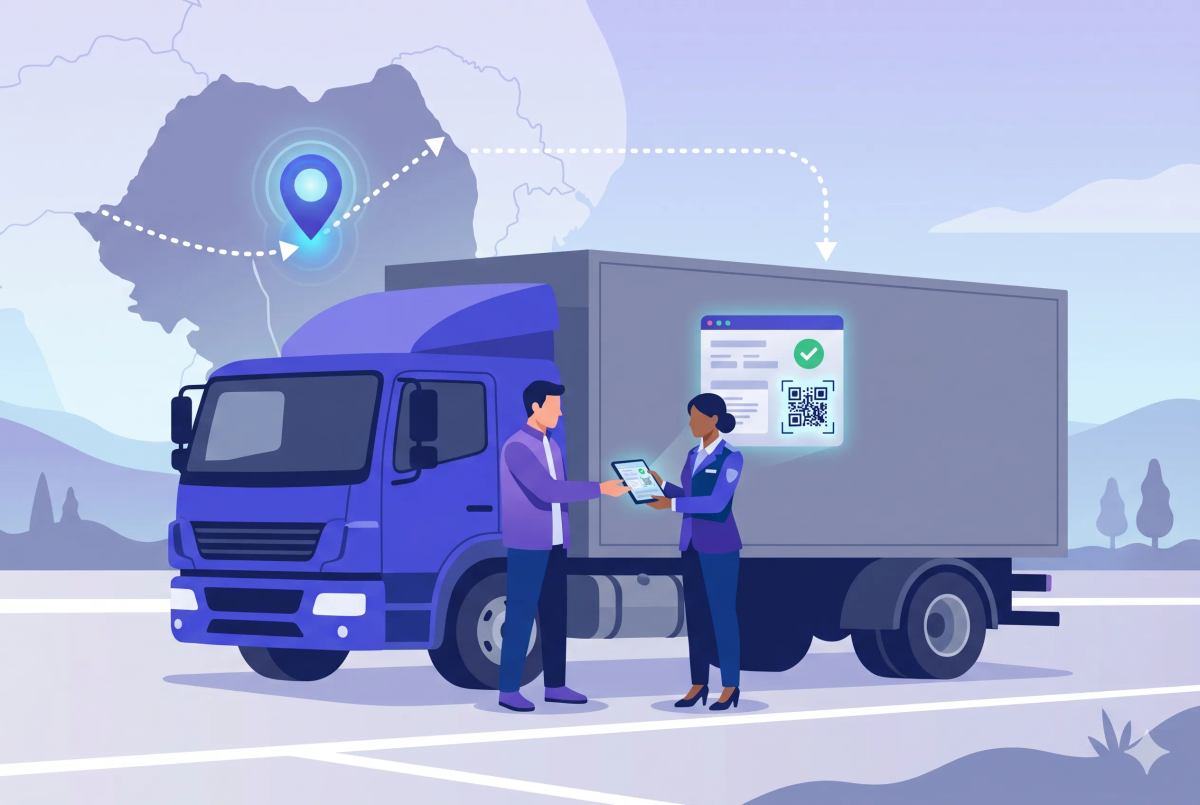
The statutory user submits the data through the SPV or API, and the RO e-Transport system automatically assigns the UIT code; being the carrier alone does not make the carrier the declarant. The user must provide the code to the carrier, directly or through the transport organiser, before entry into Romania, import or actual departure, depending on the operation.
How is the UIT code obtained?
- The statutory user signs into the SPV, directly or through a representative.
- They complete the Ministry of Finance application or send the data through the API.
- They declare the consignor, beneficiary, goods, value, locations, start date, vehicle and carrier.
- The system validates the data and automatically assigns the UIT code.
- The user gives the code to the carrier, and the carrier makes it available to the driver in an intelligible form.
Data can be declared no more than 3 calendar days before the declared start date and no later than the deadline applying to that operation. Integrated software can submit the XML file; the RO e-Transport system assigns the code, not the third-party application.
How long is the UIT code valid?
The UIT code is generally valid for 5 calendar days; the 15-day period applies to intra-Community acquisitions and the specific operations expressly listed in Article 11(2) of OUG 41/2022. Both periods run from the declared transport start date.
| Situation | Validity |
|---|---|
| General rule | 5 calendar days |
| Intra-Community acquisition and the specific operations in Article 2 point 9(g) and (j) | 15 calendar days |
“15 days for every international transport” is therefore incorrect. If a transport cannot finish within the validity period, the procedure requires it to be rejected in the system and declared again to obtain a new code.
What duties does the carrier have?
The transport organiser or carrier, as applicable, must update the vehicle identity when it changes, before the vehicle resumes movement.
For a monitored transport, the carrier must:
- receive the UIT code from the statutory user and make it available to the driver;
- transfer current positioning data for the monitored route;
- ensure that the automatic device works or, where there is no compatible automatic device, use the terminal and module supplied by the authorities.
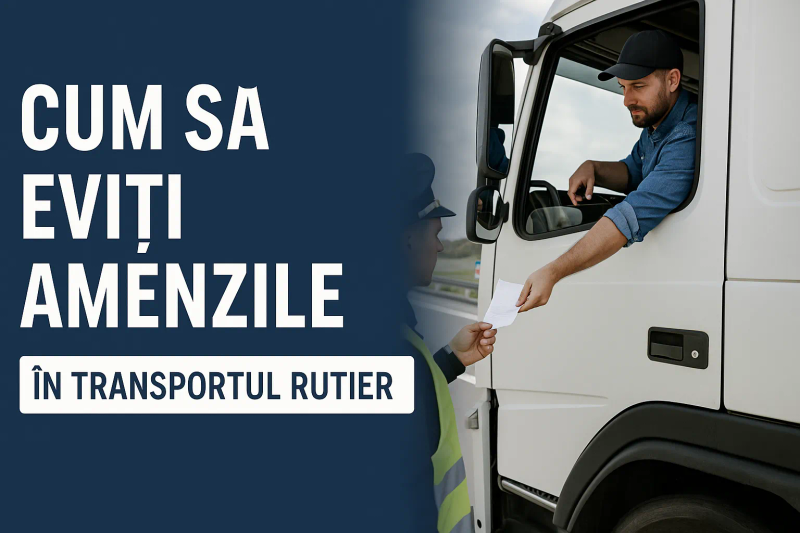
The driver starts the device before the Romanian leg begins and stops it after delivery at the declared Romanian location or after leaving Romania. At a check, the driver presents the transport documents and UIT code to the competent authorities: ANAF, the Romanian Customs Authority or the Romanian Police.
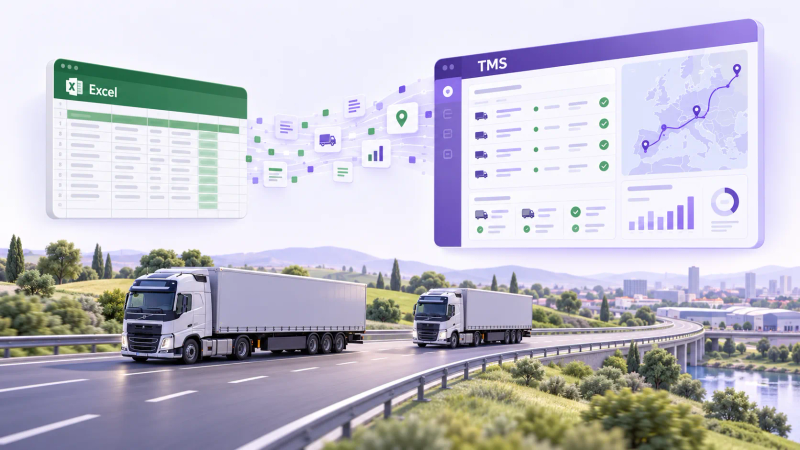
Commercial fleet tracking and statutory transmission to ANAF are different data flows. Seeing the truck on a dispatch map does not prove that the position associated with the UIT code reaches the RO e-Transport system.
What fines apply in 2026?
For several declaration and data-transfer breaches, fines reach 50,000 lei for individuals and 100,000 lei for legal entities; for certain driver breaches, the fine is between 5,000 and 10,000 lei.
| Breach category | Penalty under OUG 41/2022 |
|---|---|
| Failure to declare, use of an expired UIT, quantity discrepancies and other offences under Article 13^1(1)(a)-(c) | 10,000-50,000 lei for individuals; 20,000-100,000 lei for legal entities |
| Carrier failure to meet the positioning duties in Article 8^2 | 10,000-50,000 lei for individuals; 20,000-100,000 lei for legal entities |
| Certain driver duties concerning the device and presentation of documents/UIT | 5,000-10,000 lei |
Confiscation is not automatically added to every first fine. For certain repeated offences under Article 13^1(1)(a) and (b), the law provides progressive rates of 15%, 50% and 100% of the value of undeclared goods, with recurrence rules and exceptions that must be read in the consolidated text.
Checklist before the Romanian leg
- Classify the operation: domestic high-tax-risk goods or international transport?
- Apply the threshold formula: vehicle of at least 2.5 tonnes and consignment over 500 kg or over 10,000 lei.
- Identify the statutory user: who must declare this specific operation?
- Check the UIT: assigned by the system, valid on the start date and supplied to the carrier/driver.
- Check the vehicle: registration and any vehicle change are updated in time.
- Check ANAF positioning: the device and UIT-code association are ready for the Romanian leg.
- Prepare the documents: the document accompanying the goods and the UIT code are available at a check.
For broader operational controls, see the European road-transport fines risk checklist.
Frequently asked questions about Romania e-Transport
Which transports fall under Romania e-Transport?
In Romania, the system monitors domestic transports of high-tax-risk goods and international transports of goods on the Romanian leg, when the applicable thresholds are exceeded.
What are the Romania e-Transport thresholds?
The vehicle must have a maximum technically permissible mass of at least 2.5 tonnes, and at least one consignment must exceed 500 kg gross mass or 10,000 lei in total value.
Who generates the UIT code?
The statutory user submits the data through the SPV or API, and the RO e-Transport system automatically assigns the UIT code; being the carrier alone does not make the carrier the declarant.
How long is the UIT code valid?
The UIT code is generally valid for 5 calendar days; the 15-day period applies to intra-Community acquisitions and the specific operations expressly listed in Article 11(2) of OUG 41/2022.
What are the Romania e-Transport fines?
For several declaration and data-transfer breaches, fines reach 50,000 lei for individuals and 100,000 lei for legal entities; for certain driver breaches, the fine is between 5,000 and 10,000 lei.
What remains essential?
In 2026, treat three responsibilities separately: declaration by the statutory user, the carrier’s operations and the driver’s actions on the Romanian leg. The UIT code, vehicle identity, positioning transmission to ANAF and control documents are separate checks.