
How do you calculate freight forwarder profit margin per shipment?
Gross profit per shipment equals customer revenue minus the carrier cost and other direct costs attributable to that shipment. Gross margin expresses that result as a percentage of customer revenue:
Gross margin % = gross profit ÷ customer revenue × 100
For a freight forwarder, the calculation starts with the sell rate agreed with the customer and the buy rate confirmed with the carrier. It becomes reliable only after every direct accessorial and operational cost is attached to the same shipment.
This is a shipment-level commercial result, not the company’s net profit. Net profit also includes overhead, finance costs, tax and other expenses for the period.
What belongs in the shipment margin calculation?
Bring every value into the same calculation currency and separate three groups.
| Component | What it includes | Effect |
|---|---|---|
| Customer revenue | freight charge, detention and accepted additional services | + |
| Carrier cost | confirmed buy rate, approved accessorials and final carrier invoice | − |
| Direct operating costs | charges, documents, commissions or other costs attributable to the shipment | − |
Do not silently allocate every company expense to each shipment. Overhead such as office rent and administrative salaries can be analysed separately or distributed through a stable internal rule. The important point is consistency: changing the allocation rule each month makes shipment profitability impossible to compare.
How do buy rate and sell rate affect gross profit?
The sell rate is the price charged to the customer. The buy rate is the price paid to the subcontracted carrier. Their difference is the starting spread, but it is not always the final gross profit.
Gross profit per shipment = sell rate − carrier buy rate − other direct costs
If the carrier adds an approved waiting charge, an extra stop or a route change, that cost reduces gross profit unless the corresponding service is also accepted and billed to the customer.
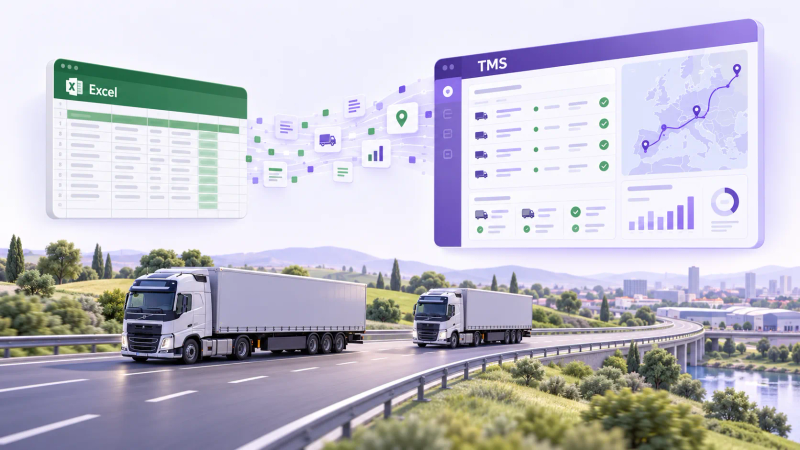
This is why a buy-versus-sell report is useful but incomplete when accessorials and other direct expenses live in email threads, spreadsheets or a separate accounting tool.
Worked example: gross profit and margin per shipment
Assume an international road shipment subcontracted to a carrier. These figures are illustrative, not recommended market rates.
| Item | Amount |
|---|---|
| Customer sell rate | €1,850 |
| Confirmed carrier buy rate | €1,480 |
| Other direct operating costs | €95 |
| Gross profit | €275 |
The calculation is:
€1,850 − €1,480 − €95 = €275
Gross margin as a percentage of customer revenue is:
€275 ÷ €1,850 × 100 = 14.86%
The shipment therefore produces €275 of gross profit at a 14.86% gross margin in this example. It does not represent the company’s net profit after overhead, finance costs and tax.
What is the difference between freight markup and margin?
Markup divides gross profit by cost, while margin divides gross profit by customer revenue. The two percentages are not equal.
In the example above, total direct cost is €1,575:
- markup: €275 ÷ €1,575 × 100 = 17.46%;
- margin: €275 ÷ €1,850 × 100 = 14.86%.
If sales negotiates in markup while management reports gross margin, name the metric on every dashboard and report. Otherwise, two people can discuss the same shipment using different percentages and both appear correct.
Where does freight forwarding margin leak?
Margin leakage usually happens between the initial quote and financial closure, not in one dramatic event.
The final carrier cost differs from the booking
The carrier may invoice detention, extra mileage or another approved service. If the cost is valid but missing from the customer’s final price, it reduces shipment profit directly.
Customer accessorials are not invoiced
Waiting time, an address change, handling or an additional stop must be documented and commercially accepted. A service recorded only in an email does not become revenue.
Revenue and cost use different currencies
When the customer pays in EUR and a carrier or direct expense is paid in another currency, compare the values using a defined exchange rate and retain the rate used. For the Romanian invoicing workflow, see the RO e-Factura transport guide.
Costs arrive after the customer invoice
A margin based only on the customer rate and the initial carrier booking is an estimate. Recheck the shipment after the final carrier invoice and all direct expenses are recorded.
Dossier and transport-order profitability are mixed
A dossier may group the commercial relationship and documents for several transport orders. Measure each execution unit first, then roll the results up to the dossier. That shows which shipment generated margin and which one consumed it.
What is the difference between expected and actual shipment profit?
Expected profit uses the revenue and costs known when quoting, while actual profit uses final revenue and every direct cost recorded after execution.
| Stage | What the result tells you |
|---|---|
| Quote | whether the proposed rate can reach the target margin |
| Carrier confirmation | whether the confirmed buy rate preserves that target |
| Before customer invoicing | whether every billable accessorial is included |
| Final carrier cost | the actual result rather than the estimate |
The variance between expected and actual profit exposes missed accessorials, late costs, exchange-rate effects and commercial changes. A monthly total alone cannot show where the variance began.
What should you check before invoicing the customer?
A short, repeatable review prevents corrections after month-end:
- Confirm the final customer sell rate.
- Confirm the final carrier buy rate and approved accessorials.
- Attach the documents supporting detention or additional services.
- Convert all values into the analysis currency using the agreed rate.
- Compare current margin with the estimate recorded at quotation.
- Resolve unexplained differences before issuing the invoice.
For work executed with your own fleet, the cost base is different. Start with the vehicle’s real transport cost per kilometre, not a subcontractor invoice.
When should a freight forwarder check shipment margin?
Check margin when quoting, after confirming the carrier, before invoicing the customer and after recording the final carrier cost. Each checkpoint answers a different commercial question while there is still time to act.
Checking only at month-end is too late to correct the customer price, request missing proof or challenge an unexplained supplier charge.
How does Routena track profit per transport order?
Routena keeps customer revenue, carrier cost and direct operating costs on the transport order, then shows profit and margin for each job. Partner-specific currencies and automatically retrieved BNR and ECB rates support conversion for invoicing and accounting.
After the transport order is checked, Routena can issue the invoice and send it to ANAF’s SPV through the RO e-Factura workflow.
For the wider operational context, read what TMS software does for carriers and freight forwarders.
Frequently asked questions about freight forwarder margin
How do you calculate freight forwarder profit margin per shipment?
Gross profit per shipment equals customer revenue minus the carrier cost and other direct costs attributable to that shipment.
What is the difference between freight markup and margin?
Markup divides gross profit by cost, while margin divides gross profit by customer revenue. The two percentages are not equal.
What is the difference between expected and actual shipment profit?
Expected profit uses the revenue and costs known when quoting, while actual profit uses final revenue and every direct cost recorded after execution.
When should a freight forwarder check shipment margin?
Check margin when quoting, after confirming the carrier, before invoicing the customer and after recording the final carrier cost.
See shipment margin before month-end
A freight forwarding business needs more than turnover by customer or dossier. It needs to know which shipment generated gross profit, where the carrier cost changed and what must be resolved before invoicing.